Worried about finding a reliable place to enjoy your favorite casino games online? We understand that trust and safety are paramount, especially when exploring Offshore Payout Casinos for Canadians. That's why we've carefully vetted the options below, ensuring you can play with peace of mind.
01
Hollywin Casino
4.8
Extensive 4-part welcome package up to €15,000 + 350 free spins with daily cashback of up to 15% automatically credited post-welcome period
60–160 game providers including Evolution Gaming live casino with 6,000+ titles covering slots, live tables, crash games and jackpots
Fast 0–24 hour payouts and no withdrawal fees across Skrill, Neteller, Paysafecard and Visa/Mastercard, with 9 crypto coins as an optional extra
Welcome bonus
100% up to C$15,000 + 350 FS!
Curaçao Gaming Control Board—C$20 min deposit—E-wallets: 0–24 hours withdrawal—6,000+ games
Fully KSA-licensed and CRUKS-integrated since November 2022, giving Dutch players complete regulatory protection including responsible gambling tools and SEPA payouts via local entity Tincel B.V.
3,000+ games from 50+ providers including full Evolution live casino with Dutch-language dealer tables, plus an integrated sportsbook covering 25+ sports — rare single-platform combination
Ultra-fast withdrawals averaging ~5 minutes via Interac/bank transfer, with weekly no-wagering free spins available to all active players
Welcome bonus
100% up to C$260 + 26 FS!
Kansspelautoriteit—C$10 min deposit—~5 min average withdrawal—3,000+ games
5,000+ games from 30+ providers including a full live casino suite via Evolution and Pragmatic Play Live — one of the broader catalogues among PAGCOR-licensed offshore operators
Mainstream-friendly with Interac, cards and e-wallets for instant deposit and fast withdrawal — a reliable choice for CA/EN players on regulated banking rails, plus 10+ crypto options
Sports betting and esports integrated alongside casino — football-themed UX with 24/7 live chat support in multiple languages
Welcome bonus
100% up to C$500 + 200 FS!
PAGCOR—C$10 min deposit—Cards/e-wallets: 0–24 hours withdrawal—5,000+ games
We look at how licensing, dispute resolution, and fund segregation affect payout reliability. Understanding these trade-offs helps you weigh the appeal of offshore sites against the security of regulated play. The aim is a clear-eyed view, not a blanket recommendation either way.
Offshore Payout Casinos vs. Regulated Canadian Sites: Key Differences
For Canadian players considering where to place their bets, the choice between provincially regulated online casinos and offshore payout casinos often comes down to a balance of protection versus perks. Provincially managed sites, like those licensed by the Alcohol and Gaming Commission of Ontario (AGCO) and iGaming Ontario (iGO), operate under strict local guidelines. This means player funds are typically segregated, responsible gambling standards are enforced, and clear dispute resolution channels are in place. You'll usually find a defined game selection, sometimes with specific high-RTP slots or certain fast-paced options being unavailable, and bonus structures are often more conservative, perhaps a 100% match.
Offshore payout casinos, on the other hand, operate outside Canada's direct regulatory framework. While technically unauthorized in Canada, they are accessible to players and exist in a legal grey area. These platforms frequently boast a much larger selection of games, often thousands more than their provincially regulated counterparts, with offerings from providers like Pragmatic Play and Evolution Gaming. They also tend to offer more generous bonuses, with 150% matches not uncommon. The trade-off, however, involves less direct oversight regarding player fund segregation and a lack of access to mandated local responsible gambling tools. The appeal often lies in faster payout speeds and less stringent Know Your Customer (KYC) requirements, particularly at the initial deposit stage.
Your Province's One Legal Crown Site, Outside Ontario
Outside Ontario, 'regulated' does not mean a choice between competing brands, it means your province's own Crown corporation, and there is only the one. A player in British Columbia legally plays at BCLC's PlayNow, in Quebec at Loto-Quebec's Espacejeux, in Alberta at PlayAlberta under the AGLC, and across New Brunswick, Nova Scotia, Prince Edward Island and Newfoundland through Atlantic Lottery. Each of these pays out by Interac or bank transfer rather than crypto, so for a non-Ontario resident a regulated payout casino in practice means their provincial Crown platform, not a private operator advertised online.
Province / Region
Legal Crown Platform
Operator
British Columbia (and partner provinces)
PlayNow
BCLC
Quebec
Espacejeux
Loto-Quebec
Alberta
PlayAlberta
AGLC
NB / NS / PE / NL
Atlantic Lottery
Atlantic Lottery Corporation
Ontario (lottery-corp side)
OLG.ca
OLG
Legality of Playing at Offshore Payout Casinos in Canada
The legal landscape surrounding online gambling in Canada can feel a bit complex, especially when it comes to offshore payout casinos. Under the Criminal Code of Canada, specifically Section 207, gambling activities are generally prohibited unless they are conducted and managed by a provincial government. This framework makes offshore operators technically unauthorized to offer services within Canada.
However, the enforcement of these laws primarily targets the operators themselves, not individual Canadian players. This creates what's commonly referred to as a legal 'grey area.' To date, there are no documented cases of Canadian players being prosecuted for simply accessing or playing at offshore gambling sites. While the operators might be outside the direct legal purview of Canadian authorities, individual players typically face no legal repercussions for participating in games offered by these platforms. It’s a distinction that many Canadian gamblers consider when choosing their online casino.
The Offshore Grey Area
The concept of a 'grey area' for Canadian players interacting with offshore payout casinos is crucial to grasp. While the Criminal Code of Canada prohibits the operation of unlicensed gambling within the country, it doesn't explicitly criminalize an individual for playing at a site hosted outside of Canada. This means that while an offshore operator might be technically unauthorized to target Canadian residents, the act of a Canadian player participating on such a site is not actively prosecuted. This distinction is vital for those weighing their options, as it means the focus of Canadian law enforcement is on preventing illegal operations from within its borders, rather than pursuing individual players who choose to gamble internationally.
How Offshore Payout Casino Licences Compare for Canadian Players
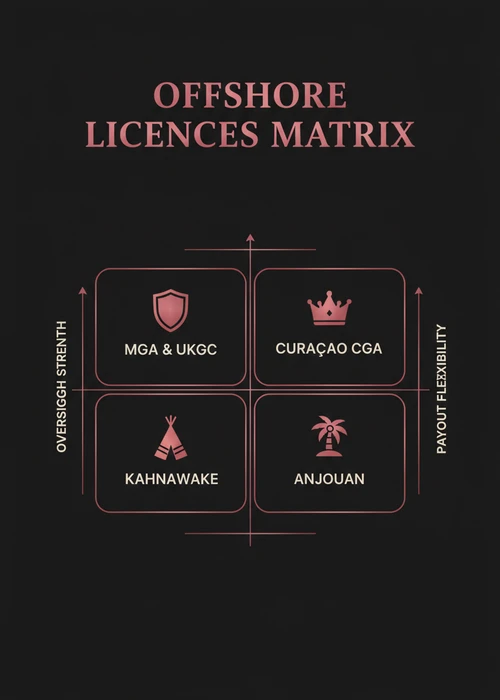
When you're looking at offshore payout casinos, the licence they hold is often the most important indicator of reliability and player protection. Various jurisdictions issue these licences, each with different standards. You'll commonly see casinos licensed by authorities such as Curacao CGA, Kahnawake, the Malta Gaming Authority (MGA), the UK Gambling Commission (UKGC), or Anjouan. These licences dictate the level of oversight, the requirements for fair play, and, crucially, the avenues for dispute resolution if something goes awry.
The MGA and UKGC are generally considered the most stringent, offering robust player protection, including segregated player funds and clear recourse mechanisms. Kahnawake, while based in Canada, operates independently and has a solid understanding of local banking, but its standards are typically seen as a step below MGA. Curacao, especially with its recent reforms, is evolving. Understanding these different tiers helps you gauge the reliability of your real money payout casino experience.
Curacao's LOK Reform Impact
The landscape for offshore payout casinos licensed in Curacao underwent a significant transformation with the introduction of the National Ordinance on Games of Chance (LOK), which came into force on December 24, 2024. This reform abolished the previous, often criticized, sublicense system, moving to direct government licensing under the Curacao Gaming Authority (CGA). For Canadian players, this change is substantial. Under the LOK, all licensed operators are now mandated to provide a certified Alternative Dispute Resolution (ADR) provider. While the CGA itself does not directly adjudicate individual player complaints, the requirement for an ADR service offers a more formal and structured path for players to address disputes, providing a much-needed layer of consumer protection that was largely absent under the old system.
The Kahnawake Gaming Commission
The Kahnawake Gaming Commission (KGC), established in 1996 and operating from the Mohawk Territory of Kahnawake in Quebec, holds a unique position in the offshore payout casino landscape for Canadian players. While technically an 'offshore' regulator in the sense that it operates outside direct federal or provincial Canadian jurisdiction, its proximity and understanding of the Canadian financial ecosystem are distinct advantages. KGC-licensed operators often demonstrate a better grasp of Canadian banking methods, including popular options like Interac and major banks such as TD and Scotia. While its regulatory standards are generally considered higher than those of Curaçao eGaming (pre-LOK), they are typically viewed as less stringent than those of the Malta Gaming Authority. Nevertheless, for many Canadian players seeking offshore options, the KGC licence offers a degree of familiarity and perceived reliability due to its local roots.
Payment Methods & Payout Speeds at Offshore Payout Casinos
Payment Method
Typical Deposit Time
Typical Withdrawal Time
Common Fees
Key Advantage for Offshore Payout Casinos
Cryptocurrencies (e.g., Bitcoin, USDT)
Near-instant
60 seconds (USDT on Tron/Solana) to 15 minutes (Bitcoin)
Minimal, often network fees
Extremely fast, often looser limits, enhanced privacy
Interac e-Transfer
Near-instant
24-48 hours
Varies by casino/bank, usually low
Widely used in Canada, familiar process
e-Wallets (e.g., Skrill, Neteller, MiFinity)
Near-instant
24-48 hours
Varies by provider, generally low
Quick processing after approval, good for multiple sites
Credit/Debit Cards (Visa, Mastercard)
Near-instant
2-5 business days
Varies, some casinos don't support withdrawals
Convenient for deposits, universally accepted
Bank Transfer
1-3 business days
3-7 business days
Can be higher for international transfers
Suitable for large withdrawals, direct to bank
Offshore payout casinos catering to Canadian players understand the need for diverse and efficient payment solutions. The table above illustrates the common methods and their associated payout speeds. Cryptocurrencies, such as Bitcoin and USDT, stand out for their exceptional speed, with USDT on Tron or Solana often arriving in under 60 seconds and Bitcoin within 10-15 minutes once confirmed on-chain. This makes them a top choice for players prioritizing instant payout casinos.
Interac e-Transfers remain a popular choice, offering near-instant deposits and withdrawals typically processed within 24-48 hours. E-wallets like Skrill and Neteller also provide quick processing times after internal casino approval. While credit/debit cards are convenient for deposits, withdrawals can take longer, and some casinos may not support them for cashouts. Offshore sites often feature more relaxed deposit limits compared to provincially regulated platforms, appealing to players who prefer higher stakes or quicker transactions without the same level of scrutiny found in regulated markets.
Why Offshore Payout Casinos Often Offer Faster Withdrawals
One of the primary draws for Canadian players to offshore payout casinos is the promise of faster withdrawals. This isn't just a marketing gimmick; there are structural reasons why these platforms can often process your winnings more quickly than some provincially regulated sites. Part of it comes down to less stringent regulatory overhead. While regulated Canadian sites must adhere to numerous compliance checks, which can add to processing times, many offshore operators, especially those focusing on cryptocurrencies, can streamline their financial operations.
The adoption of cryptocurrencies like Bitcoin and USDT is a major factor. These digital currencies allow for near-instantaneous transfers once approved, bypassing traditional banking delays. Unlike conventional banking rails, which can involve multiple intermediaries and business day limitations, crypto transactions are often processed 24/7. This efficiency, combined with sometimes looser Know Your Customer (KYC) verification processes at the initial stages, means that for many players, getting their money out of an offshore casino can indeed be a much quicker affair.
Game Selection & Bonuses at Offshore Payout Casinos
When it comes to sheer variety and generous incentives, offshore payout casinos often present a compelling alternative for Canadian players. These platforms typically offer an expansive library, frequently boasting thousands of casino games from a wide array of software providers such as NetEnt, Microgaming, and Play'n GO. This extensive selection often surpasses what's available at provincially regulated sites, which might have a more limited game pool due to specific local licensing agreements or restrictions on certain game types or return-to-player (RTP) percentages.
Beyond the games, the bonus structures at offshore casinos tend to be significantly more attractive. While a provincially regulated site might offer a 100% match bonus on a first deposit, it's not uncommon to find offshore payout casinos providing 150% match bonuses or even higher, often coupled with more free spins or other perks. These more generous promotions, combined with a broader game selection, enhance the overall player experience and are a key reason why many Canadians choose to explore these international platforms for their gambling entertainment.
Player Protection at Offshore Payout Casinos: What to Expect
When you choose to play at offshore payout casinos, it's important to understand that the level of player protection can differ significantly from what you'd experience at a provincially regulated Canadian site. A major distinction lies in the handling of player funds. Unlike regulated Ontario operators, who are mandated to segregate player funds from operational capital, many unlicensed offshore sites do not have this requirement. This means that in the event of financial difficulties for the casino, your deposited funds might not be as secure.
Furthermore, offshore platforms often lack the robust responsible gambling safeguards that are standard in regulated markets. This includes mandatory deposit limits, spending trackers, or integration with national self-exclusion systems like Ontario's BetGuard. While some offshore casinos might offer voluntary self-exclusion tools, they are not universally enforced or overseen by an independent authority. The absence of enforceable recourse mechanisms also means that if a payout is withheld or a dispute arises, your options for resolution might be limited, leaving you with fewer avenues for appeal compared to a locally licensed operator.
Recourse Gap: When an Offshore Payout Casino Withholds Winnings
One of the most significant considerations when playing at an offshore payout casino is the 'recourse gap' – what happens if the casino withholds your winnings? Unlike provincially regulated operators, where clear dispute resolution paths and segregated funds are mandatory, your options with an offshore site largely hinge on its licensing. If you're playing at an unlicensed offshore platform, you essentially have no enforceable recourse. There's no governing body to appeal to, and your chances of recovering funds can be slim.
However, the situation improves with licensed offshore sites, particularly those under the Curacao LOK (in force since December 24, 2024), which mandates the provision of a certified Alternative Dispute Resolution (ADR) provider. While the Curacao Gaming Authority (CGA) itself won't adjudicate your complaint, the ADR service offers a formal channel. Stronger licences like the MGA or UKGC provide even more robust player protection and direct complaint procedures. Ultimately, the licence tier of your chosen offshore payout casino defines your leverage and what steps you can take if a payout is unfairly delayed or denied.
Where to File Complaints
If an offshore payout casino is withholding your winnings, your course of action depends entirely on its licensing body. For a site licensed by the Malta Gaming Authority (MGA) or the UK Gambling Commission (UKGC), you can typically file a complaint directly with the regulator, which offers formal channels and strong player protection. If the casino operates under a Curacao licence, especially post-LOK (effective December 24, 2024), they are required to provide access to a certified Alternative Dispute Resolution (ADR) provider, which is your primary avenue for complaint. However, if the offshore payout operator is unlicensed or holds a very light-touch licence like Anjouan, your options are severely limited, and you may find yourself with no binding recourse at all. Always check the licence before depositing, as it's your only real leverage.
Self-Exclusion & Responsible Gaming at Offshore Payout Casinos
Self-exclusion and responsible gaming measures are crucial for player well-being, but their application differs between regulated and offshore platforms. In Ontario, for instance, the BetGuard centralized self-exclusion tool, launched May 14, 2026, blocks access to all 82 iGaming Ontario (iGO) regulated sites. This provides a comprehensive safety net for players within the provincial framework. However, this robust system does not extend to offshore payout operators. This creates a significant gap in player protection, as a player who has self-excluded from a regulated site could still access and play at an offshore casino.
While many offshore casinos offer their own internal self-exclusion options, these are typically managed directly by the operator and are not part of a unified, independently verified system. Players needing support can contact resources like Gambling Help Online at 1800 858 858 or visit gamblinghelponline.org.au. However, these tools primarily serve regulated environments. For those who frequently use offshore sites, alternative blocking tools like BetBlocker or Gamban can provide an additional layer of personal control, though they require proactive installation and management by the individual.
Are Winnings from Offshore Payout Casinos Taxable in Canada?
One common question Canadian players have about offshore payout casinos revolves around the tax implications of their winnings. The good news for recreational gamblers in Canada is that, generally, gambling winnings are not considered taxable income. This applies regardless of whether you've won at a provincially regulated casino or an offshore payout casino.
The Canada Revenue Agency (CRA) views recreational gambling as a hobby, not a source of income, meaning your jackpot or big payout typically won't be subject to income tax. This tax-free status holds true as long as gambling is not your primary source of income and you are not operating as a professional gambler. For the vast majority of Canadian players who enjoy online casinos for entertainment, winnings from offshore sites can be enjoyed without needing to report them on their annual tax returns.
Navigating KYC and Verification at Offshore Payout Casinos
While some offshore payout casinos might market themselves with phrases like 'no-KYC' or promise minimal verification at signup, it's important to understand the practical reality of Know Your Customer (KYC) processes. Even at these seemingly lax platforms, KYC verification is almost always triggered at some point, particularly when you request a withdrawal. This is especially true for larger sums, typically over C$5,000, but can occur for any payout.
During this verification, you will generally be asked to provide standard documentation: a government-issued ID (such as a driver's license or passport) and proof of address (like a utility bill or bank statement from the last three months). Some casinos might also request a selfie or video verification. This process is a standard anti-money laundering (AML) measure and is common across the online gambling industry, regardless of the casino's licensing jurisdiction. So, while you might get started quickly, expect to complete verification before you can cash out your winnings from an offshore payout casino.
Do Offshore Sites Skip ID?
Offshore payout casinos might appear to skip verification during the initial signup process, often allowing players to register and deposit with minimal fuss. However, this impression is largely misleading when it comes to withdrawals. The reality is that Know Your Customer (KYC) protocols are almost universally triggered when a player attempts to cash out their winnings, especially for amounts exceeding approximately C$5,000. At this stage, players will need to provide standard identification documents, such as a government-issued ID and proof of address. So, while the initial barrier to entry might be lower, the verification process is simply deferred, not eliminated, even on 'no-KYC' offshore payout brands.
Key Regulatory Changes Affecting Offshore Payout Casinos for Canadians
The Canadian gambling landscape has seen several significant regulatory changes in recent years, though their direct impact on offshore payout casinos varies. Bill C-218, which legalized single-event sports betting nationwide, received Royal Assent on June 29, 2021, and came into force on August 27, 2021. This primarily affected provincially regulated sports betting options. Ontario then launched its regulated iGaming market in April 2022, creating a competitive, open market for private operators under the AGCO and iGO. More recently, Alberta passed Bill 16 in June 2024, paving the way for its own regulated iGaming market, anticipated as early as late 2025 or July 13, 2026.
These changes, while transformative for the Canadian domestic market, primarily govern operators within provincial jurisdiction. Offshore payout casinos, by their nature, exist outside these direct regulatory frameworks. While increased provincial regulation might influence player behaviour or market share, the fundamental operations and accessibility of offshore sites for Canadians remain largely unaffected by these domestic shifts. For example, the Ontario Court of Appeal's November 2025 ruling regarding cross-border play for regulated sites doesn't directly alter how offshore casinos operate, though it could influence the competitive landscape in the long run.
How to Choose Between Offshore Payout Casino Licences
When you're navigating the world of offshore payout casinos, the licence held by an operator is your most reliable guide to security and fair play. Think of it as your primary leverage if any issues arise. Licences from the Malta Gaming Authority (MGA) and the UK Gambling Commission (UKGC) are generally considered the gold standard, offering robust player protection, including segregated funds and clear, enforceable recourse channels. These are often the preferred choice for players who prioritize stringent oversight.
MGA and UKGC: Offer the highest level of player protection, including ring-fenced funds and formal dispute resolution pathways.
Kahnawake Gaming Commission: A mid-tier option, based in Canada, with a good understanding of local banking systems like Interac, TD, and Scotia, and requiring sites to be hosted within its territory.
Curacao Gaming Authority (post-LOK, effective December 24, 2024): Also mid-tier, now with direct licensing and mandatory Alternative Dispute Resolution (ADR) providers, offering a more structured complaint process than before.
Anjouan: Generally considered a lighter-touch licence, offering less comprehensive player protection and fewer formal recourse options.
Weighing these licence tiers against other factors like payment options, cryptocurrency payout speed, and the existence of a certified ADR path is crucial. Your choice of licence directly defines your potential recourse if a payout is withheld by an offshore casino.
The Safest Offshore Licence
For Canadian players considering offshore payout casinos, the licences offering the most robust protection are typically those from the Malta Gaming Authority (MGA) and the UK Gambling Commission (UKGC). These regulators enforce strict rules regarding segregated player funds and provide formal, enforceable channels for dispute resolution. Following these in terms of protection are the Kahnawake Gaming Commission and the Curacao Gaming Authority (especially post-LOK, effective December 24, 2024), which now mandates certified Alternative Dispute Resolution (ADR) providers. Conversely, an unlicensed offshore payout site or one with a very light-touch licence offers minimal to no binding recourse, leaving players with significantly less protection.
Canadian Responsible Gambling Resources (Not for Offshore Payout Casinos)
It's important for Canadian players to understand that while provincially regulated gambling sites are mandated to link to and integrate with local responsible gambling resources, offshore payout casinos typically do not. These offshore platforms operate outside Canadian jurisdiction, meaning they aren't bound by provincial requirements to provide access to tools like Ontario's BetGuard, British Columbia's BCLC GameSense, or the OLG My PlayBreak program. These provincial resources are specifically designed to support players within the regulated Canadian market.
For Canadians using offshore payout casinos, this creates a responsibility to proactively seek out support if needed. While the offshore sites themselves may offer some internal self-exclusion options, they are not part of a unified, independently monitored system. Players in need of assistance can still access national and provincial helplines, such as ConnexOntario at 1-866-531-2600, which offers free and confidential support 24/7. However, these services are not directly integrated with offshore operators, meaning players must take the initiative to connect with them independently.
Q&A
Frequently Asked Questions
Q1
Are offshore payout casinos legal for Canadians to play at?
While offshore operators are technically unauthorized in Canada under the Criminal Code, enforcement targets operators, not individual players. There are no documented cases of Canadian players being prosecuted for using offshore sites, placing them in a legal grey area for players.
Q2
What's the main advantage of offshore payout casinos for Canadian players?
Offshore payout casinos often offer significantly faster withdrawals, particularly with cryptocurrencies, which can process in minutes compared to days for traditional methods. They also typically feature a wider game selection and more generous bonus offers than provincially regulated sites.
Q3
How does Curacao's LOK reform impact offshore payout casinos?
Effective December 24, 2024, Curacao's LOK abolished the old sublicense system, moving to direct CGA licensing and mandating certified Alternative Dispute Resolution (ADR) providers. This offers a more formal complaint channel for players, improving protection compared to the previous system.
Q4
Are winnings from offshore payout casinos taxable in Canada?
No, recreational gambling winnings in Canada are generally tax-free, regardless of whether they come from a provincially regulated or an offshore payout casino. This applies as long as gambling is not considered your primary professional income source.
Q5
Will I need to complete KYC verification at an offshore payout casino?
Yes, while some offshore sites offer 'no-KYC' signups, Know Your Customer (KYC) verification is almost always triggered for withdrawals, especially for amounts over C$5,000. You'll typically need to provide government ID and proof of address before cashing out.
Hollywin Casino
100% up to C$15,000 + 350 FS100% up to C$15,000 + 350 FS